Los Angeles commercial property owners are raising the bar on workplace cleanliness — and for good reason. Post-pandemic expectations have permanently shifted what tenants, employees, and clients consider "clean enough." If your building isn't meeting the new standard, you're already behind. Contact S&W Janitorial Services at (323) 264-7800 to find out where your property stands.
From the high-rises of Downtown Los Angeles to the sprawling tech campuses along Silicon Beach, office managers and property owners across LA County are discovering that surface-level cleaning no longer cuts it. A mop and a bottle of all-purpose spray won't protect a workforce of 50 people sharing elevator buttons, conference room chairs, and communal coffee machines. The hygiene protocols that matter in 2026 are more deliberate, more documented, and more science-backed than anything we saw before 2020.
This guide breaks down exactly what peak office hygiene looks like for Los Angeles commercial properties — covering high-risk touchpoints, air quality solutions, employee-facing protocols, and LA County compliance requirements.
The highest-risk surfaces in any shared office are the ones touched most frequently and cleaned least often: elevator buttons, door handles, shared keyboards, faucet handles, and breakroom appliances. In DTLA high-rises and Silicon Beach open-plan offices, these touchpoints can accumulate bacteria within 2 hours of a morning cleaning if they aren't treated with antimicrobial products.
Research consistently shows that a single contaminated surface in a communal area can spread pathogens to 50% of an office's workers and surfaces within 4 hours. That's not a slow creep — that's a morning.
Common high-risk zones we see in LA commercial buildings include:
For office cleaning in Commerce, California and across Los Angeles, a proper touchpoint protocol means disinfecting these surfaces at least twice daily, not once. In high-traffic buildings, that number goes up to three or four times during peak hours.
Yes — and the data is hard to ignore. Poor indoor air quality accounts for an estimated 10 million lost workdays annually across the U.S., and office buildings with inadequate ventilation see significantly higher rates of respiratory illness, absenteeism, and reduced cognitive function among occupants.
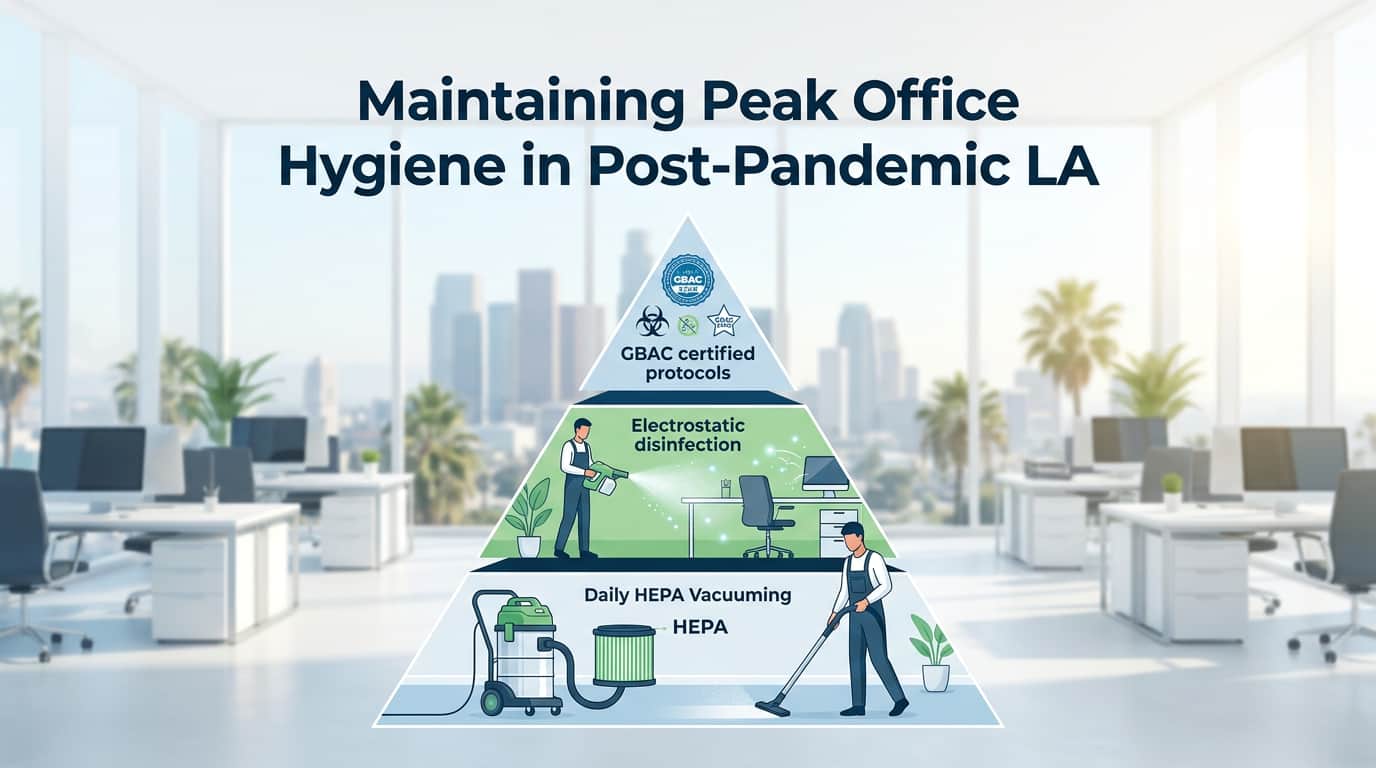
Medical-grade air filtration addresses this directly. HEPA filtration systems capture particles as small as 0.3 microns — that includes most airborne bacteria, dust, allergens, and virus-carrying droplets. In a standard 2,000 square foot office suite in DTLA, a properly sized HEPA system can cycle the room's air 6 times per hour, reducing airborne contaminants by up to 99.97%.
Pairing HEPA filtration with GBAC (Global Biorisk Advisory Council) protocols — the same standards used in healthcare facilities — is quickly becoming the benchmark for serious commercial property owners. GBAC-aligned cleaning programs include:
Antimicrobial surface coatings are another layer worth considering. Applied to door handles, light switches, and countertops, these coatings provide 24/7 antimicrobial protection between scheduled cleanings. Costs typically range from $500 to $2,500 per application depending on square footage, and most products carry a 90-day efficacy period.
The physical cleaning program only works when your team reinforces it. A cleaning crew can't undo the damage caused by an employee who eats lunch at their desk every day, skips hand washing, or leaves shared equipment contaminated.
Building a workplace hygiene culture means making the right behavior easy and visible. Here's what that looks like in practice:
Post clear protocols in shared spaces. Simple signage in kitchens and restrooms — "Wipe down surfaces after use" — reduces contamination by reminding people of their role.
Place hand sanitizer dispensers at every entry point and shared workstation cluster. When sanitizer is within arm's reach, usage rates jump significantly. Studies show that strategically placed dispensers increase hand hygiene compliance by up to 40% in office environments.
Schedule deep cleaning around your team's rhythms. Our cleaning teams typically recommend a twice-weekly deep clean for offices with 20 or more employees, with daily surface disinfection. Offices that follow this schedule report up to 30% fewer sick days in a 12-month period compared to those relying on weekly-only cleaning.
Communicate your standards to tenants and employees. When people know their property manager takes hygiene seriously, trust and satisfaction scores go up. That matters at lease renewal time.
For property owners managing commercial construction cleaning before a new tenant moves in, establishing clean baselines before occupancy is especially critical. Post-construction dust and particulates can linger in HVAC systems for weeks if not properly addressed, affecting air quality from day one.
Los Angeles County periodically updates its environmental health guidelines for commercial workplaces, and 2026 has brought renewed focus on ventilation standards and disinfection documentation. Property owners managing buildings in areas like Downtown LA, Culver City, and the Commerce industrial corridor should be aware of the following current expectations:
For office cleaning in Commerce, California specifically, properties along the East Washington Boulevard corridor often house logistics, distribution, and light manufacturing operations where hygiene protocols also need to account for warehouse adjacency and high employee turnover. The cleaning approach for those environments differs from a standard DTLA suite, and cookie-cutter cleaning contracts rarely serve them well.
Partnering with a janitorial service that understands LA County's specific landscape — not just generic commercial cleaning standards — makes a real difference in how effectively your building stays compliant and competitive.
The office buildings that retain tenants and command strong lease rates in 2026 share a common trait: they treat cleanliness as a building system, not a weekly chore. That means scheduled protocols, documented compliance, air quality management, and a cleaning partner who understands what "clean" actually means in a post-pandemic commercial environment.
For office cleaning in Commerce, California and across Los Angeles County, S&W Janitorial Services brings GBAC-aligned protocols, experienced crews, and flexible scheduling designed for commercial properties of all sizes. Whether you're managing a DTLA office suite, a Silicon Beach co-working campus, or an industrial facility near the Commerce corridor, the right cleaning program protects your occupants, your reputation, and your bottom line.
Call S&W Janitorial Services today at (323) 264-7800 to schedule a free walkthrough and quote.