Facility managers in Los Angeles are dealing with a real problem right now: janitorial labor costs keep rising, qualified staff are harder to find, and tenants expect cleaner, more sanitized spaces than ever before. Robotic cleaning technology is changing how commercial buildings get cleaned, and the numbers are hard to ignore. If you manage a high-traffic facility in the LA area, S&W Janitorial Services can help you figure out whether integrating automated cleaning tools is the right move for your building. Call (323) 264-7800 for a free consultation.
This post breaks down what's actually happening with commercial cleaning robots in 2026, where adoption is accelerating, what the technology looks like on the ground, and how facilities are pairing robots with human crews to get better results at lower costs.
Los Angeles facility managers are adopting automated cleaning tools at a higher rate than most U.S. markets because of three specific pressures: high labor costs, a chronic shortage of janitorial workers, and buildings that operate around the clock. California's minimum wage increases have pushed commercial cleaning labor costs up significantly over the past three years. For large facilities, that adds up fast.
High-traffic venues near Downtown LA, the Arts District, and areas like Koreatown see continuous foot traffic from early morning through late evening. A robotic floor scrubber doesn't need a break. It doesn't call in sick. It runs its programmed route during off-peak hours and logs every square foot it covers. For a facility manager responsible for a 200,000-square-foot commercial building, that kind of consistency matters.
Coastal humidity and the city's year-round event calendar also mean floors, lobbies, and restrooms take a beating every single day. Robots handle that volume well.
Three categories of automated cleaning technology are showing up regularly in Los Angeles commercial facilities right now.
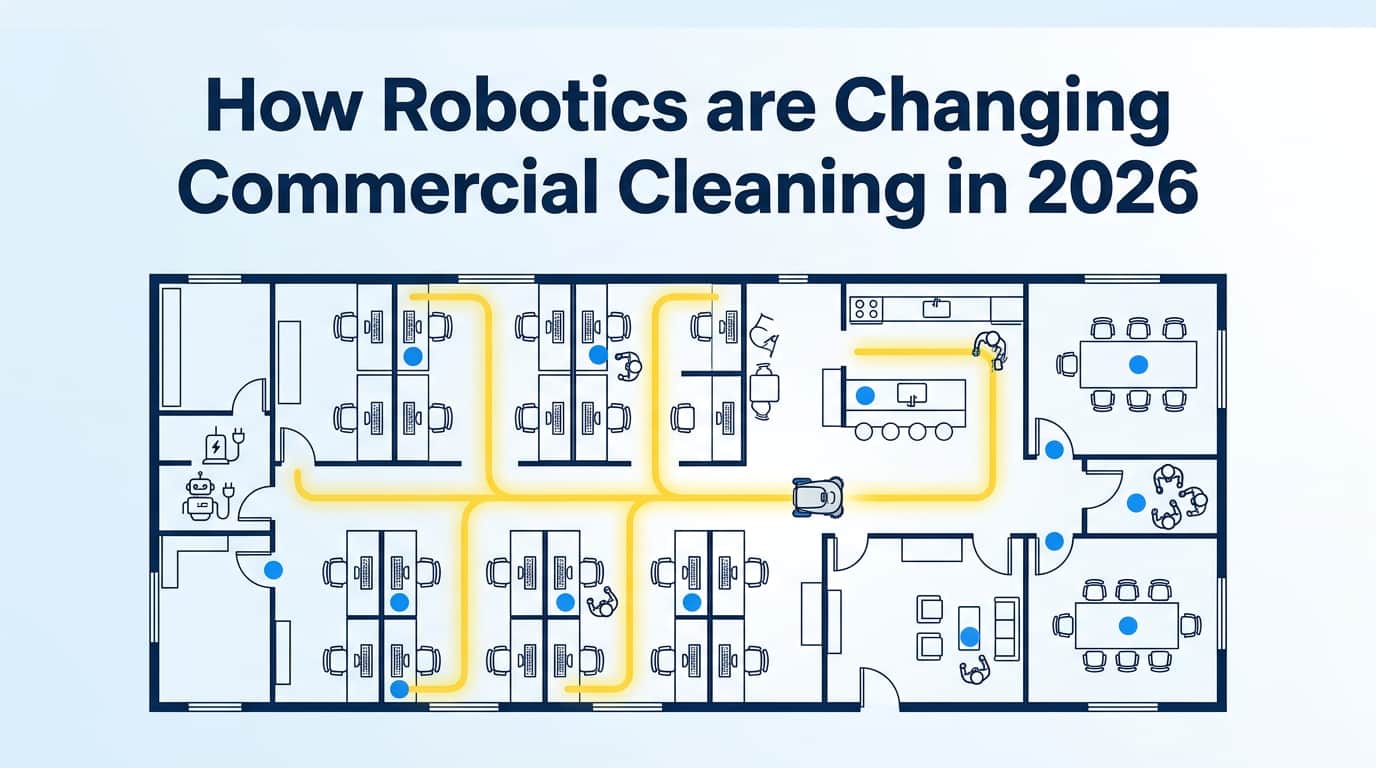
AI-driven autonomous floor scrubbers are the most widely deployed. These machines use LiDAR sensors and onboard cameras to map a building's floor plan, avoid obstacles, and clean the same path consistently every time. A single autonomous scrubber can cover between 30,000 and 50,000 square feet per shift, which would take a human worker significantly longer to complete manually.
IoT-connected sensor systems are changing how cleaning schedules get set. Instead of cleaning a restroom on a fixed 2-hour schedule regardless of use, smart sensors track occupancy and trigger cleaning alerts based on actual traffic. Facilities using this approach report a 20–30% reduction in unnecessary cleaning cycles, which translates directly to labor savings without any drop in cleanliness standards.
Electrostatic disinfecting robots became common after 2020 and haven't left the market. These units apply disinfectant in a fine, even charge that coats surfaces more thoroughly than a manual spray-and-wipe approach. For medical office buildings, schools, and food-adjacent facilities across the LA basin, these robots are handling nightly disinfection cycles that previously required multiple workers.
For facilities looking to keep their office environments consistently clean alongside robotic solutions, S&W Janitorial's office cleaning services offer the human-led complement that makes the whole system work.
The commercial cleaning industry across Los Angeles is short-staffed. This isn't a new problem, but it has become more acute. Turnover rates in janitorial services nationally hover around 200% annually, meaning the average cleaning worker stays in a position for roughly six months. Recruiting, onboarding, and training replacement staff costs facilities real money, often estimated at $1,500 to $3,000 per worker cycle.
Robotic units reduce that dependency. A single autonomous scrubber, priced between $25,000 and $75,000 depending on capability, typically pays for itself within 18 to 24 months when you account for reduced labor hours on routine floor maintenance. That's not a reason to eliminate your cleaning crew. It's a reason to redeploy them.
Buildings near the Staples Center corridor and large mixed-use developments in Culver City are already using this model. The robot handles the floors. The human team handles restrooms, glass, high-touch surfaces, and anything requiring judgment or flexibility.
No. Robots don't replace janitorial crews, and facilities that try to use them as a direct one-for-one replacement run into problems quickly.
Here's what we see consistently: robotic floor scrubbers handle repetitive, high-volume tasks well. They don't handle spills, trash removal, window cleaning, or anything that requires a person to assess a situation and respond. Human crews handle those tasks better and faster than any current robotic system.
The smarter approach treats robots as an extension of your team. A janitorial supervisor still oversees the operation, reviews the robot's cleaning logs, addresses any areas flagged as missed or incomplete, and manages all the tasks that require human judgment. For commercial construction cleaning, for example, post-build cleanups still require experienced human workers who can handle debris, polish floors to spec, and prepare a space for occupancy. No robot handles that reliably yet.
Facilities that work with S&W Janitorial Services integrate automated tools into a cleaning program that still has qualified people running the job from start to finish.
The answer depends on your building's size, traffic volume, and budget. Here's a practical breakdown:
Robotic cleaning makes financial sense for facilities over 50,000 square feet with consistent daily traffic. For smaller buildings or spaces with complex layouts, irregular hours, or specialized cleaning needs, the ROI timeline stretches out considerably, sometimes beyond five years.
Start by auditing your current cleaning costs. If your floor maintenance labor runs more than $8,000 to $12,000 per month for a single shift, an autonomous scrubber probably pays off within two years. If you're spending less than that, the math gets tighter.
IoT sensor systems have a lower barrier to entry, often running $500 to $2,000 per zone in installation costs, and they deliver measurable efficiency gains even in smaller facilities by reducing wasted cleaning cycles.
The best outcomes we see come from facilities that pair the right technology with an experienced janitorial service that knows how to manage both the robots and the human crew working alongside them.
Robotic cleaning tools are a real part of commercial facility management in Los Angeles in 2026. They cut costs on high-volume floor maintenance, reduce dependence on a tight labor market, and deliver more consistent sanitation data than traditional methods. But they work best as part of a managed cleaning program, not as a standalone solution.
If you're evaluating how to improve your building's cleaning operation, S&W Janitorial Services can assess your facility and put together a program that fits your space, your schedule, and your budget. Call (323) 264-7800 today to get started.